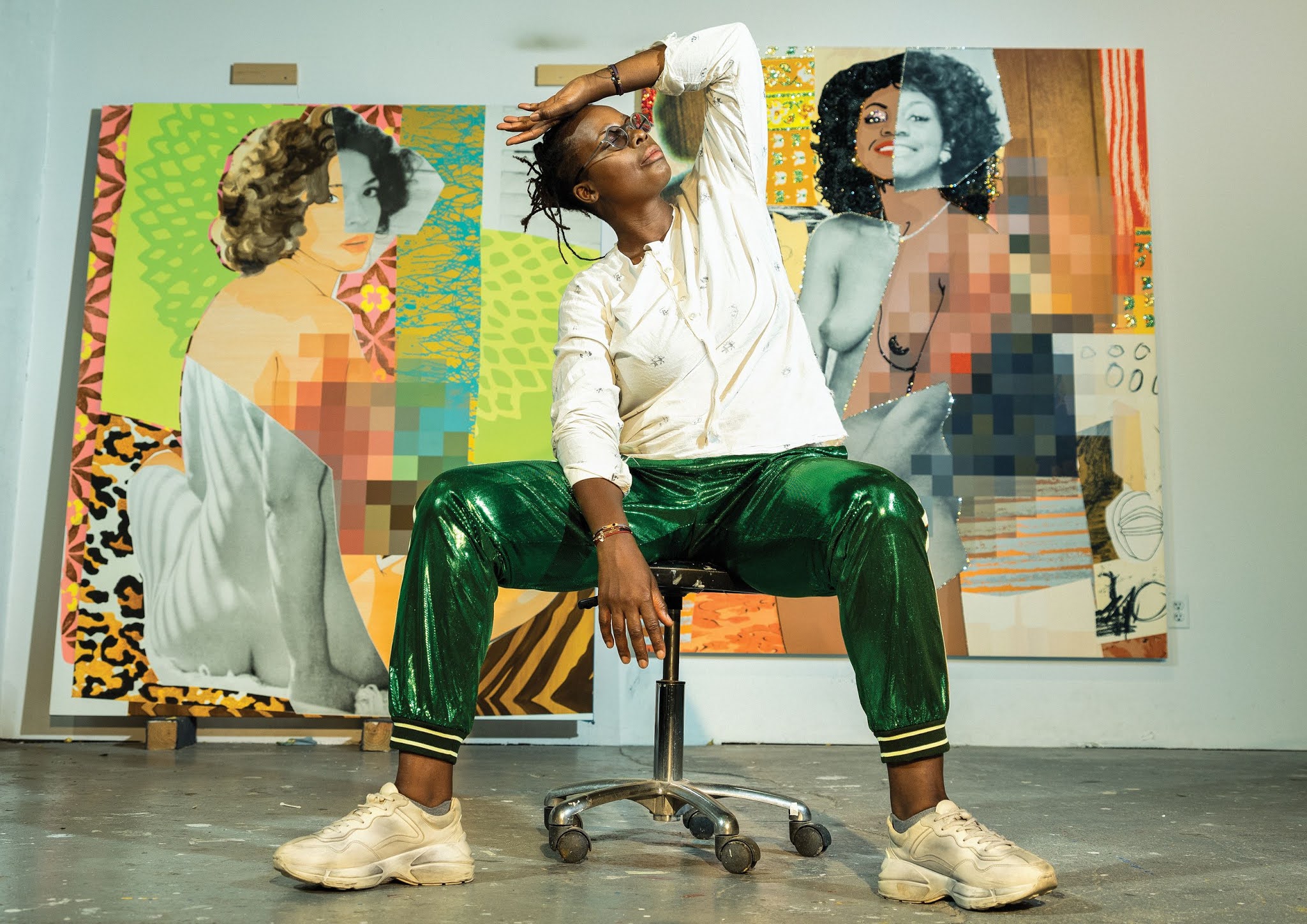
Wednesday, October 7, 2020

Deconstructing the Gaze


Ways Of Seeing by John Berger 

  • “A woman must continually watch herself. She is almost continually accompanied by her own image of herself...From earliest childhood, she has been taught and persuaded to survey herself continuously.” (Berger 46)
  • “Nakedness reveals itself. Nudity is placed on display. To be naked is to be without disguise. To be on display is to have the surface of one’s own body, turned into a disguise which, in that situation, can never be discarded. The nude is condemned to never being naked. Nudity is a form of dress.” (Berger 54)

Understanding Patriarchy
  • “Patriarchy is a political-social system that insists that males are inherently dominating, superior to everything and everyone deemed weak, especially females, and endowed with the right to dominate...”
  • “Citizens in this nation fear challenging patriarchy even as they lack overt awareness that they are fearful, so deeply embedded in our collective unconscious are the rules of patriarchy.”

The Oppositional Gaze 
  • “To experience pleasure, Miss Pauline sitting in the dark must imagine herself transformed, turned into the white woman portrayed on the screen. After watching movies, feeling the pleasure, she says, “But it made coming home hard.”
  • “Mainstream feminist film criticism in no way acknowledges black female spectatorship. It does not consider the possibility that women can construct an oppositional gaze via an understanding and awareness of the politics of race and racism.”

Mickalene Thomas -Photographed, Collaged and Painted Muses
  • “By portraying real women with their own unique history, beauty and background, I’m working to diversify the representations of black women in art.” 
  • “Instead, the photos question art historical traditions of objectifying women”

Overlooked No More: Ana Mendieta, a Cuban Artist Who Pushed Boundaries
  • “She urged viewers to disregard their gender, race or other defining societal factors and instead connect with the humanity they share with others.”
  • “It’s about theater. It’s about kind of capturing moments through various forms of documentation. And she takes all of these things to the world at large that might not be considered fine arts. She turns them into something intelligent, harrowing and emotional.”


Lesly's Selfie


John Berger, Chapters 2+3

- "Every one of her actions - whatever its direct purpose or motivation - is also read as an indication of how she would like to be treated". 

- "You painted a naked wona becasye you enjoyed looking at her, you put a mirror in her hand and you called the painting vanity, the morally condemning the woman whose nakedness you had depicted for your own pleasure".

Bell hooks, Understanding Patriarchy,

- "I was always more interested in changing patriarchy than my brother was because it was the system that was always leaving me out of things that I wanted to be part of". 

- Dismantling and changing patriarchal culture is work that men and women must do together". 

The Oppositional Gaze

- "The extent to which black women feel devalued, objectified, dehumanized in this society determines the scope and texture of their looking relations". 

- "Watching movies from a female perspective, Muley arrived at that location of disaffection that is the starting point for many black women approaching cinema within the lived harsh reality of racism". 

Mickalene Thomas -Photographed, Collaged, and Painted Muses

- "By selecting women of color, I am quite literally raising their visibility and inserting their presence into the conversation"

- "These hyperreal images have all the glamor and amped up sexuality as artful fashion photography ... but none of the airbrushing or homogeneity of subject endemic to glossy magazines

Overlooked No More: Ana Mendieta, a Cuban Artist Who Pushed Boundaries

- "As an immigrant, Mendieta felt a disconnect in the United States. The trauma of being uprooted from her Cuban homeland as a girl would leave her with questions about her identity and make her more conscious of being a woman of color".

- "She urged viewers to disregard their gender, race or other defining societal factors and instead connect with the humanity they share with others".

Merret Hennes: Ana Mendieta


             Way of Seeing - John Berger

  1. “..she comes to consider the surveyor and the surveyed within her as the two constituent yet always distinct elements of her identity as a woman.She has to survey everything she is and everything she does because how she appears to others, and ultimately how she appears to men, is of crucial importance for what is normally thought of as the success of her life. Her own sense of being in herself is supplanted by a sense of being appreciated as herself by another.”

  2. "You painted a naked woman because you enjoyed looking at her, you put a mirror in her hand and you called the painting Vanity, thus morally condemning the woman whose nakedness you had depicted for your own pleasure." 


Overlooked No More: Ana Mendieta, a Cuban Artist Who Pushed Boundaries

  1. “questions would echo in her work, which explored themes that pushed ethnic, sexual, moral, religious and political boundaries. She urged viewers to disregard their gender, race or other defining societal factors and instead connect with the  humanity they share with others.”

  2.  she takes all of these things to the world at large that might not be considered fine arts. She turns them into something intelligent, harrowing and emotional.”


            The Photographed, Collaged, and Painted Muses of Mickalene Thomas

  1. “By selecting women of color, I am quite literally raising their visibility and inserting their presence into the conversation,” Thomas said in a recent interview. “By portraying real women with their own unique history, beauty and background, I’m working to diversify the representations of black women in art.”


            Understanding Patriarchy

  1. “The word “patriarchy” just is not a part of their normal everyday thought or speech. Men who have heard and know the word usually associate it with women’s liberation, with feminism, and therefore dismiss it as irrelevant to their own experiences”

  2. “growing up is the system of patriarchy, even if we never know the word, because patriarchal gender roles are assigned to us as children and we are given continual guidance about the ways we can best fulfill these roles.”


Nashira Banks Selfie and Quotes


Overlooked No More: Ana Mendieta, a Cuban Artist Who Pushed Boundaries 

·         “It’s about kind of capturing moments through various forms of documentation. And she takes all these things to the world at large that might not be considered fine arts. She turns them into something intelligent, harrowing and emotional.”

·         “She urged viewers to disregard their gender, race or other defining societal factors and instead connect with the humanity they share with others.”

Mickalene Thomas -Photographed, Collaged and Painted Muses

·         “By selecting women of color, I am quite literally raising their visibility and inserting their presence into the conversation.”

·         “By portraying real women with their own unique history, beauty and background.”

John Berger, Chapters 2+3

·         “Men act and women appear.”

·         “A woman’s presence expresses her own attitude to herself and defines what can and cannot be done to her.”

Understanding Patriarchy

·         “Patriarchy is the single most life-threatening social disease assaulting the male body and spirit in our nation.”

·         “To indoctrinate boys into the rules of patriarchy, we force them to feel pain and to deny their feelings.”

The oppositional gaze

·         “Not only will I stare. I want my look to change reality.”

·         “We are afraid to talk about ourselves as spectators because we have been so abused by ‘the gaze’ ”.


My Vanity and Me ~ Luz


The Photographed, Collaged and Painted Muses of Mickalene Thomas

“By selecting women of color, I am quite literally raising their visibility and inserting their presence into the conversation.”

“But the social commentary in her work is never heavy-handed or preachy; her approach throughout is both playful and political.”


 Overlooked No More: Ana Mendieta, a Cuban Artist Who Pushed Boundaries

She urged viewers to disregard their gender, race or other defining societal factors and instead connect with the humanity they share with others.

It’s about kind of capturing moments through various forms of documentation.


Understanding Patriarchy

“growing up is the system of patriarchy, even if we never know the word, because patriarchal gender roles are assigned to us as children and we are given continual guidance about the ways we can best fulfill these roles.”

“Most of us learned patriarchal attitudes in our family origin, and they were usually taught to us by our mothers.”


The Oppositional Gaze

“Unless you went to work in the white world, across the tracks, you learned to look at white people by staring at them on the screen.”

“The extend to which black women feel devalued, objectified, dehumanized in this society determines the scope and texture of their looking relations.”


Way of Seeing - John Berger

“Consequently, how a woman appears to a man can determine how she will be treated.”

“To be naked is to be oneself. To be nude is to be seen naked by others and yet not recognized for oneself. A naked body has to be seen as an object in order to become a nude.”


Short Response 

To understand male gaze, it is important to consider the consequence of an act. As Berger states, “how a woman appears to a man can determine how she will be treated.” For instance, if a woman is beautiful to behold, the man may pursue her whereas if the man does not fancy her, he will avert his gaze. These chapters by John Berger, there is a focus on nude from European oil painting where were portrayed as subjects. This nudity stands as “criteria and conventions by which women have been seen and judged as sights.” In other words, the author makes several references to the Eurocentric standard of beauty being the focal point for women. This perspective enables this patriarchal impression to dictate the treatment of women based on their skin color, shape, and other physical features. To retaliate against this view, one way to understand ourselves is to understand what it means to be naked, which is to be oneself. This view is a self-focused idea where the goal is to recognize the beauty that lies in women bodies. Unlike this notion of being naked is to be nude, where one's naked self is unrecognizable and objectified which is what the male gaze employs if left unchallenged. Unfortunately, most women, like myself, have grown accustomed to this theory of male gaze. This idea of how women should be “are assigned to us as children,” where it is taught to us in our family origin, particularly “taught to us by our mothers.”


Who Cares!!! Let us be! -Jenn A


Way of Seeing - John Berger

1. "To be naked is to be oneself. To be nude is to be seen naked by others and yet not recognized in order to become a nude. Nakedness reveals itself. Nudity is placed on display."

2. "Their nakedness acts a confirmation and proves a very strong sense of relief. She is a woman like any other: or he is a man like no other: we are overwhelmed by the marvelous simplicity of the familiar sexual mechanism"

Understanding Patriarchy 

1. "Women are asking men to share the public reins and men can’t bear it. Ask antifeminists and you will get a diagnosis that is, in one respect, similar. Men are troubled, many conservative pundits say, because women have gone far beyond their demands for equal treatment and are now trying to take power and control away from men...The underlying message: men cannot be men, only eunuchs, if they are not in control. Both the feminist and antifeminist views are rooted in a peculiarly modern American perception that to be a man means to be at the controls and at all times to feel yourself in control."


2. "As their daughter I was taught that it was my role to serve, to be weak, to be free from the burden of thinking, to caretake and nurture others. My brother was taught that it was his role to be served; to provide; to be strong; to think, strategize, and plan; and to refuse to caretake or nurture others. I was taught that it was not proper for a female to be violent, that it was “unnatural.”

The Oppositional Gaze

1. “Identifying with neither the phallocentric gaze nor the construction of white-womanhood as lack, critical black female spectators construct a theory of looking relations where cinematic visual delight is the pleasure of interrogation” 

2. "Even when representations of black women were present in film, our bodies and being were there to serve”

Photographed Collaged and Painted Muse

"Muse is a show that lays bare the artist’s process in a refreshingly nonlinear way. The curation, which consists of four distinct parts in a kind of nesting doll arrangement, lets the viewer draw her own connections between Thomas’s work in various mediums and that of her influences."

"Wan, at the end of her life, she talks candidly about her struggles with addiction and marital troubles. It’s a moving piece, and its place at the center of the show casts Bush as the spiritual core of Thomas’s work, her mother as creator, the muse that all the others followed."

Overlooked No More: Ana Mendieta, A Cuban artist who pushed boundaries

"These questions would echo in her work, which explored themes that pushed ethnic, sexual, moral, religious and political boundaries. She urged viewers to disregard their gender, race or other defining societal factors and instead connect with the humanity they share with others."

"The making of my ‘Silueta’ in nature keeps the transition between my homeland and my new home,” she once said. “It is a way of reclaiming my roots and becoming one with nature. Although the culture in which I live is part of me, my roots and cultural identity are a result of my Cuban heritage."


Nadia - "I've Been Good to Me"


 Ways of Seeing Chapters 2-3

"You painted a naked woman because you enjoyed looking at her, you put a mirror in her hand and you called the painting Vanity, thus morally condemning the woman whose nakedness you had depicted for your own pleasure." 

"But the essential way of seeing women, the essential use to which their images are put, has not changed. Women are depicted in a quite different way from men - not because the feminine is different from the masculine - but because the 'ideal' spectator is always assumed to be male and the image of the woman is designed to flatter him." 

Understanding Patriarchy

"Of these systems the one that we all learn the most about growing up is the system of patriarchy, even if we never know the word, because patriarchal gender roles are assigned to us as children and we are given continual guidance about the ways we can best fulfill these roles." 

"Often in my lectures when I use the phrase 'imperialistic white-supremacist capitalist patriarchy' to describe our nation's political system, audiences laugh. No one has ever explained why accurately naming this system is funny. The laughter is itself a weapon of patriarchal terrorism. It functions as a disclaimer, discounting the significance of what is being named. It suggests that the words themselves are problematic and not the system they describe."

The Oppositional Gaze

"By courageously looking, we defiantly declared: 'Not only will I stare. I want my look to change reality.'"

"One learns to look a certain way in order to resist." 

The Photographed, Collaged, and Painted Muses of Mickalene Thomas

“By selecting women of color, I am quite literally raising their visibility and inserting their presence into the conversation,” Thomas said in a recent interview. “By portraying real women with their own unique history, beauty and background, I’m working to diversify the representations of black women in art.”

"Thomas’s jazzy photomontages of women’s limbs and facial features can be construed as commentary on how female bodies are brutally picked apart in contemporary visual culture. But the social commentary in her work is never heavy-handed or preachy; her approach throughout is both playful and political."

Overlooked No More: Ana Mendieta, a Cuban Artist Who Pushed Boundaries

"These questions would echo in  her work, which explored themes that pushed ethnic, sexual, moral, religious and political boundaries. She urged viewers to disregard their gender, race or other defining societal factors and instead connect with the  humanity they share with others." 

“There’s a way in which her work is about performance... It’s about theater. It’s about kind of capturing moments through various forms of documentation. And she takes all of these things to the world at large that might not be considered fine arts. She turns them into something intelligent, harrowing and emotional.”


Tuesday, October 6, 2020

Naked


John Berger Quotes

1-”Aman’s presence is dependent upon the promise of power which he embodies.”

2-”By contrast, a woman's presence expresses her own attitude to herself, and defines what can and cannot be done to her.


Bell Hooks Quotes

Understanding Patriarchy 

1-”Patriarchal gender roles are assigned to us as children and we are given continual guidance about the ways we can best fulfill these roles.”

2-”It is no accident that feminist began to use the word “patriarchy” to replace the commonly used “male chauvanism” and “sexism.” 


The Oppositional Gaze

1-”The error is not to conceptualize this ‘presence’ in terms of power, but to locate that power is wholly external to us--as extrinsic force.”

2-”When black women actresses like Lena Horne appeared in mainstream cinema most white viewers were not aware that they were looking at black females unless the film was specifically coded as being about blacks.”


Mickalene Thomas -Photographed, Collaged and Painted Muses

1- “By selecting women of color, I am quite literally raising their visibility and inserting their presence into the conversation.”

2- “By portraying real women with their own unique history, beauty and background, I’m working to diversify the representations of black women in art.” 


Overlooked No More: Ana Mendieta, a Cuban Artist Who Pushed Boundaries | NYTimes

1- “She incorporated unusual natural materials like blood, dirt, water and fire.”

2- “These questions would echo in  her work, which explored themes that pushed ethnic, sexual, moral, religious and political boundaries.”


Austin Quotes + Selfie "Creatively Black"

 John Berger "Way Of Seeing" Chapter 2-3 Quotes

"To be naked is to be oneself. To be nude is to be seen naked by others and yet not recognized for oneself. A naked body has to be seen as an object in order to become a nude."

"To be naked is to be without disguise. To be on display is to have the surface of one’s own skin, the hairs of one’s own body, turned into a disguise which, in that situation, can never be discarded. The nude is condemned to never being naked. Nudity is a form of dress"

Understanding Patriarchy

"Patriarchy is a political-social system that insists that males are inherently dominating, superior to everything and everyone deemed weak, especially females"

"To indoctrinate boys into the rules of patriarchy, we force them to feel pain and to deny their feelings."

The Oppositional Gaze 

"Interrogating black looks were mainly concerned with issues of race and racism, the way racial domination of blacks by white overdetermined representation."

"The politics of slavery, of racialized power relations, were such that the slaves were denied their right to gaze"

Mickalene Thomas - Photographed, Collaged, and Painted Muse

"New Jersey-born, Brooklyn-based artist Mickalene Thomas is best known for her richly textured, rhinestone-encrusted paintings of African-American women and bright, collaged interiors."

“By portraying real women with their own unique history, beauty and background, I’m working to diversify the representations of black women in art.”

Overlooked No More: Ana Mendieta, a Cuban Artist Who Pushed Boundaries | NYTimes

"She incorporated unusual natural materials like blood, dirt, water and fire, and displayed her work through photography, film and live performances."

"Ana Mendieta’s art was sometimes violent, often unapologetically feminist and usually raw."


Relaxed and In Power - Fransheska Larios

Ways of seeing

  1. “To be born a woman has been to be born, within an allotted and confined space, into the keeping of men. The social presence of women has developed as a result of their ingenuity in living under such tutelage within such a limited space.”

  2. “In the art-form of the European nude, the painters and spectator-owners were usually men and the persons treated as objects, usually women. This unequal relationship is so deeply embedded in our culture that it still structures the consciousness of many women.”

Understanding Patriarchy 

  1. “As their daughter, I was taught that it was my role to serve, to be weak, to be free from the burden of thinking, to caretake and nurture others. My brother was taught that it was his role to be served; to provide; to be strong; to think, strategize, and plan; and to refuse to caretake and nurture others.”

  2. Keeping males and females from telling the truth about what happens to them in families is one-way Patriarchal culture is maintained.”

The Oppositional Gaze

  1. “Since I knew as a child that the dominating power adults exercised over me and over my gaze was never so absolute that I did not dare to look, to sneak a peak, to stare dangerously, I knew that the slaves had looked. That all attempts to repress our/black peoples’ right to gaze had produced in us an overwhelming longing to look, a rebellious desire, an oppositional gaze.” 

  2. “Not only will I stare. I want my look to change reality.”

The Photographed, Collaged and Painted Muses of Mickalene Thomas

  1. “Thomas’s jazzy photomontages of women’s limbs and facial features can be construed as commentary on how female bodies are brutally picked apart in contemporary visual culture. But the social commentary in her work is never heavy-handed or preachy; her approach throughout is both playful and political.”

  2. “By selecting women of color, I am quite literally raising their visibility and inserting their presence into the conversation,”

Overlooked No More: Ana Mendieta, a Cuban Artist Who Pushed Boundaries

  1. She urged viewers to disregard their gender, race or other defining societal factors and instead connect with the humanity they share with others.

  2. It is a way of reclaiming my roots and becoming one with nature. Although the culture in which I live is part of me, my roots and cultural identity are a result of my Cuban heritage.”