Luzangela Martinez
Professor
Doris Cacoilo
ART
242 Self: Image
4
November 2020
Short Essay #1: Andy Warhol and
Jean-Michel Basquiat
Personality is not permanent. In our
lifetime, there will be many personal experiences that can significantly shape
our aspirations, social behavior, and personality. Often, these encounters take
place because of our gender, race, culture, economic status, and appearance.
Indeed, our personality is a collection of personal experiences. In the same
way, an artist’s past will greatly influence their work style. For example, artists
like Andy Warhol and Jean-Michel Basquiat had impactful experiences from their
childhood to their adult years. As a result, both their artworks reflected
prevalent themes of fame and mortality.
Andy Warhol, a leading artist of the
1960s Pop Art Movement, experienced a fatal sickness during his childhood which
stirred his obsession with celebrities and fame. At the age of eight, Warhol
developed a disorder that resulted in involuntary movements of the body called
Sydenham Chorea. As a result, it left him bedridden for several months. During
this time, he would obsessively skim through comics and celebrity magazines to
escape boredom. If he were to go out, it was to see movies that had his
favorite actresses or actors. Ultimately, his childhood fascination of comics,
and celebrity tabloid magazines and movies resulted in his attraction for
celebrities, mass consumerism, and money. During the 1960s, there were various
Hollywood icons that were adored and idolized by many. However, none can
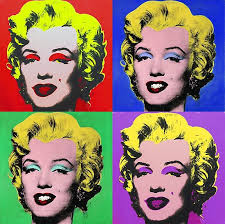
compare to Marilyn Monroe, who had a mythical status as a Hollywood icon. It
was for this reason that Warhol decided to recreate a series of images of
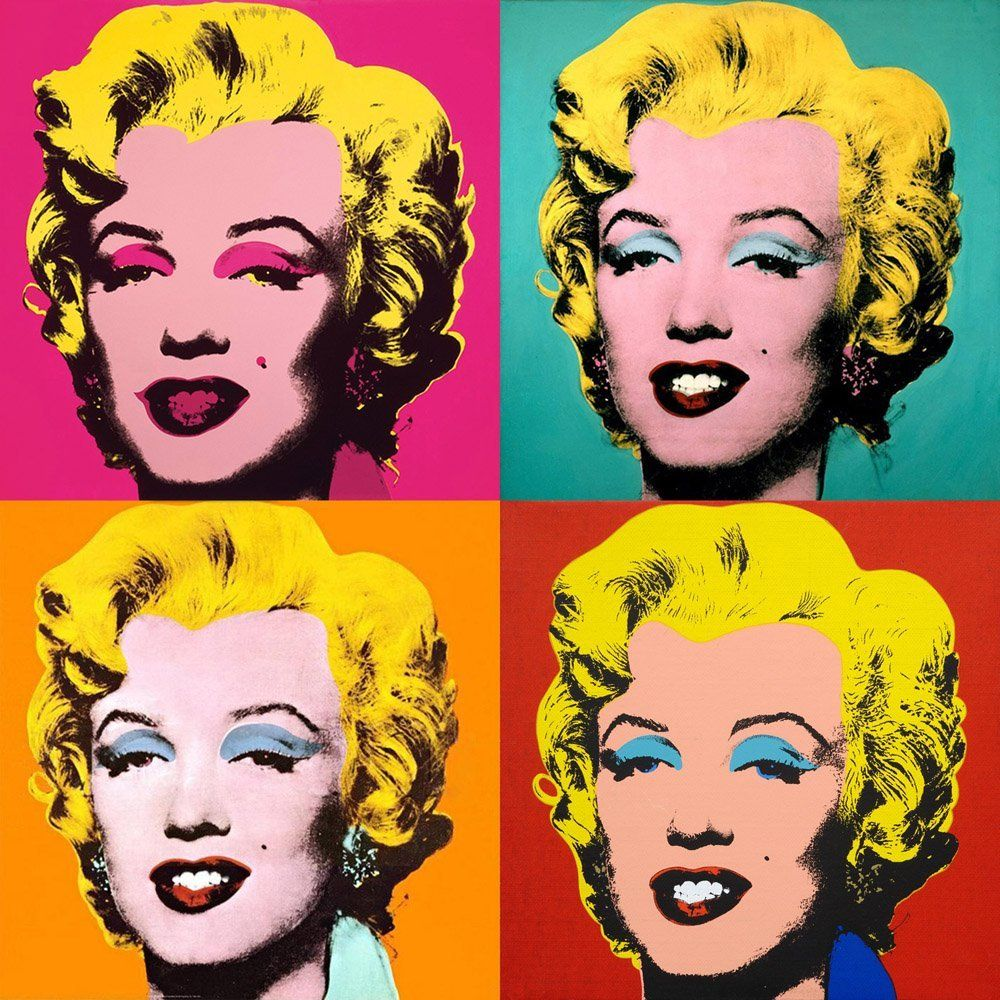
Marilyn Monroe (see Figure 1). In his Marilyn Monroe series, Warhol utilized
bright and vivid colors
that enabled his work to stand out. Also, he used a diptych style, a technique commonly
used for portraying saints in Eastern Orthodox and Catholic Churches. By
placing Marilyn’s portrait in this style, he connects the idolization both
saints and Marilyn Monroe received from people. Lastly, his idea of repeating
the image of Marilyn Monroe symbolized the mass production that was seen in the
early 1960s due to the post-war economic boom. Joanne Finkelstein, the author
of The Art of Self Invention once stated that, “In every social
encounter, we are directed to think about how to make a good impression and how
to influence the opinion of others. We pay attention to the other, and they
turn and pay attention to us” (Finkelstein). Ultimately, this is true for Warhol’s
Marilyn Monroe series because he portrays her as a perfect saint-like figure with
rarely any flaws to sell her looks, which highlights the themes of celebrity
and fame.
In addition, Warhol’s past
experiences with death assisted in developing his deep attraction for mortality.
When Warhol was a teenager, his beloved father, Andrej Warhola, died of
tuberculosis peritonitis. It was also believed that his poor recovery after
having a gallbladder surgery played a significant role. As accustomed by most
Greek Catholics, Andrej’s body laid in the family living room for three days.
As a result, this became a very traumatic experience for Warhol as he refused
to leave his room. Not only did this impact Warhol as a teenager, but it also
greatly influenced his artwork as well. As writer and artist, Dahlia Elsayed,
once said, “for artists in general, a lot of things start with the personal”
(“Painting With Words,
Writing With Color.”). Ultimately, this explains the
reasoning behind Warhol’s choice of creating the Marilyn Monroe series two
weeks after her death. It also explains his decision in painting Red Jackie and
Blue Jackie after the assassination of her husband and the United States’
35th president, John F. Kennedy (see Figure 2). As John Berger once said, “If you buy a
painting you buy also the look of the thing it represents” (Berger 83). Ultimately, this
is true for the paintings shown in Figure 2 that represent the theme of death and
disaster. Warhol had another life-changing experience when he was shot by
Valerie Solanas, a radical feminist author. After spending months at the
hospital, Warhol was obligated to wear a surgical corset to hold his organs in
place. Unlike other past experiences, his work became more focused on death by
including several skulls and guns in his paintings.
In a similar way, Jean-Michel
Basquiat’s artwork also highlights the theme of death. This predominant theme
observed in many of his pieces was influenced by past childhood experiences.
For example, at the age of eight, Basquiat was hit by a car causing him to
spend a month in the hospital. Similar to Warhol’s experience, Basquiat escaped
boredom by reading and skimming through a copy of the 19th century
anatomical textbook Grey’s Anatomy. As a “way of marking the
experience,” Basquiat would incorporate words he learned from the textbook into
his work (“Painting With Words,
Writing With Color.”). For example, in the In Italian work, Basquiat added
words like “corpus,” “sangre,” and “blood” (see Figure 3). In other artworks,
he would include words like “ear,” “eye,” “skull,” “jaw,” “diagram of the heart
pumping blood,” and “scapula.” Ultimately, due to this life-altering
experience, it was evident that “[t]he written word always [came] first when
[he was] doing a painting” (“Painting With Words,
Writing With Color.”). It
can also be seen that Basquiat’s paintings were “a way of reclaiming [his]
roots…..Although the culture in which [he] live [was] part of [him], [his]
roots and cultural identity are a result of” his Haitian and Puerto Rican descent
("Overlooked No More: Ana Mendieta, a Cuban Artist Who Pushed Boundaries"). As he
created more works as such, Basquiat became even more popular and recognized by
many artists like Andy Warhol. Eventually, both artists developed a unique
friendship both socially and creatively, producing joint paintings. However,
after the death of Warhol, Basquiat became a heavy drug addict and lost himself
in it. It was this experience with drugs that brought him to create one of his
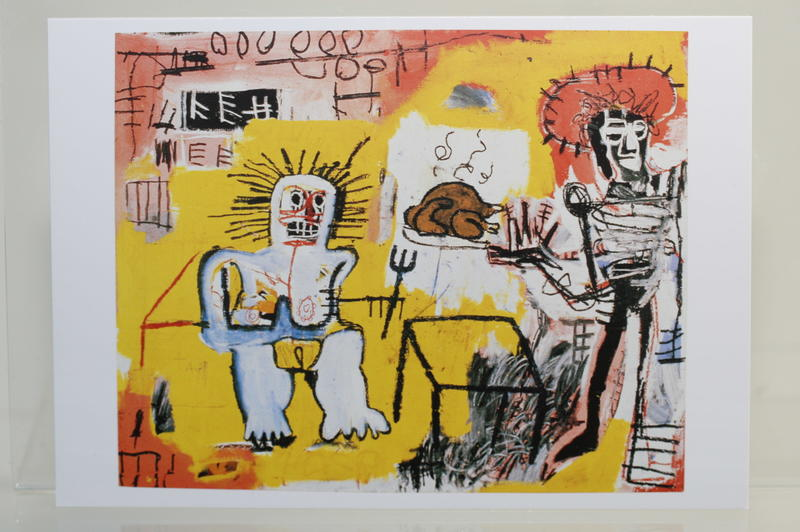
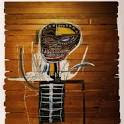
last pieces: Riding with Death. As
shown in Figure 4, it appears that Basquiat painted a black man riding a
four-legged skeleton. Once again, his use of bones in this painting highlights
his fascination with the Grey’s Anatomy textbook. Lastly, his scribbling
style demonstrates that he may have been under the influence of a hard drug.
Furthermore, Andy Warhol and
Jean-Michel Basquiat had life-changing experiences from their childhood to
their adult years. Not only did these experiences influence their personalities,
but it also impacted their artistic sides. Both artists utilized different
techniques to convey the same themes of death. It was also observed that
Warhol’s childhood obsession of celebrities and fame also influenced his work.
Figure 1: Marilyn Monroe Series created by Andy
Warhol
Figure 2: The
figure to the left is (a) Red Jackie, and to the right is
(b) Blue Jackie. Both pieces were
created by Andry Warhol.
Figure 3: In
Italian created by Jean-Michel Basquiat.
Figure 4: Riding
with Death created by Jean-Michel Basquiat.
Works
Cited
Berger, John. Ways of Seeing. 1972.
Finkelstein, Joanne. The Art of Self
Invention: Image and Identity in Popular Visual Culture. I. B. Tauris,
2007.
Gorce, Tammy La. “Painting With Words,
Writing With Color.” The New York Times, The New York Times, 16 Jan.
2014,
www.nytimes.com/2014/01/19/nyregion/a-review-of-dahlia-elsayed-hither-and-yon-at-new-jersey-state-museum.html.
“Overlooked No More: Ana Mendieta, a Cuban
Artist Who Pushed Boundaries.” The New York Times, The New York Times,
19 Sept. 2018,
www.nytimes.com/2018/09/19/obituaries/ana-mendieta-overlooked.html.
Pruitt, Sarah. “Andy Warhol Was Shot By
Valerie Solanas. It Killed Him 19 Years Later.” History.com, A&E Television
Networks, 31 May 2018,
www.history.com/news/andy-warhol-shot-valerie-solanas-the-factory.